
As we leave summer behind and head back to our still- empty classrooms, it's a good time to remember that there is a more to a welcoming space than attractive posters and cute seasonal decorations. Classroom organisation isn’t just about making things look nice. It’s also a powerful teaching tool, since the way a space is designed can either sharpen focus or lead to distraction.
So, here’s the big question: Is your classroom working for you, or against you?
As teachers, we pour energy into lesson plans and often overlook something just as influential: the physical environment. Loris Malaguzzi, founder of the Reggio Emilia approach, famously said:
“There are three teachers of children: adults, other children, and the physical environment.”
This means your classroom is an active part of the learning process.
Why Space Matters: Attention and Performance
You might be tempted to rearrange your desks, put up some posters, and be done with it, or think classroom design is just one more thing that will get stuck on your ever-growing to-do list. However, it's worth dedicating some time and energy to the space, as research in neuroeducation shows a clear link between environment and cognitive performance:
A cluttered, poorly lit, or rigid classroom can increase stress and raise cortisol levels, which makes paying attention more difficult.
A clear, flexible space helps the brain feel safe, engaged, and ready to learn.
When you strategically organise your classroom, you are using the physical environment to influence how students think, focus, and interact. Spending some time considering your classroom layout now can save you time in the long run.
Effective classroom organisation
And now for some practical tips to get you started. To design a great classroom space, you´ll want to begin by considering three elements: space, time, and resources. Basically, ask yourself where you are, what you need to do there, and how you can do it.
- Space includes:
-
-
- Furniture layout
- Clear movement pathways
- Defined zones
-
-
- Time includes:
-
-
- Transitions between activities, or flow
- How different tasks “live” in different areas
-
-
- Resources include:
-
-
- Access to materials
- Placement of books and materials
- Encouraging student autonomy
-
-
Classroom layouts to try
The best layout depends on a combination of your teaching style and objectives, and the age and number of your students. You won’t have the same setup for a small conversation class (which, by the way, may itself be set up “boardroom style” for business English or as a “comfy couch chat” for a more relaxed class) than for a class of busy preschoolers, or teens focused on external exams.
You might be drawn to one way or another, but before you start pushing desks around, spend some time considering what you and your students need. And don’t forget that you can change your classroom arrangement during the year should the need arise. Here are some ideas to get you thinking:
- Traditional Layout: Rows facing the teacher
-
- Can be appropriate for lectures or individual work
- Maximizes focus and teacher visibility
- Limits student interaction
- Might be best for older students and more formal classroom work (think: exam prep)
-
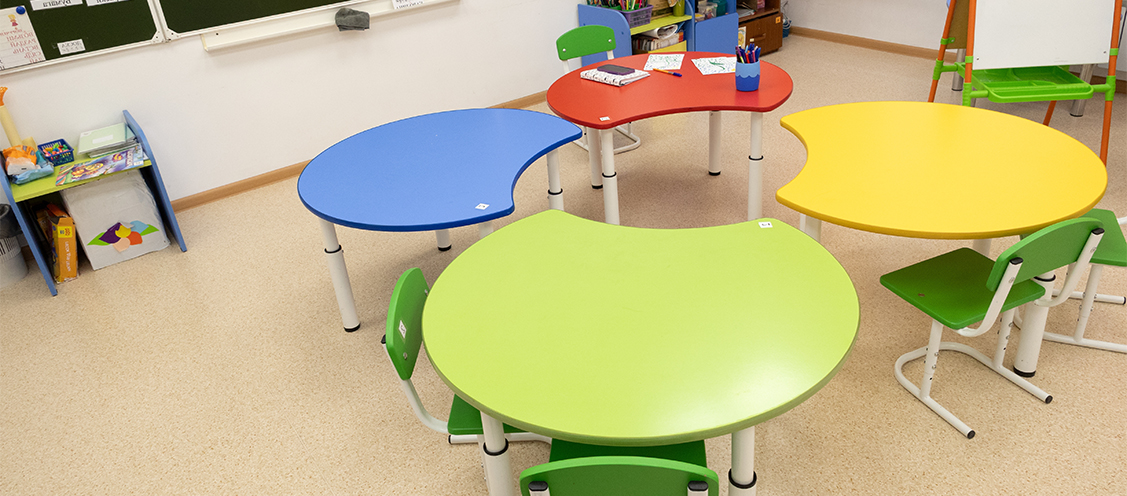
- Cooperative Learning: Group Tables
-
- Desks in small “islands” (4–5 students)
- Encourages discussion and teamwork
- Ideal for projects and problem-solving
- Builds social and communication skills
- Creates space for shared materials
- Keep in mind this type of layout is likely to result in a noisier environment overall
-
- Learning Stations (Corners)
-
- Common in early years and early primary education
- Zones for reading, art, construction, etc.
- Students rotate between activities
- Promotes independence and choice
- Allows for a hybrid setup, as students can sit at tables for specific tasks
-
- Flexible Classroom (“Flexible Seating”)
-
- Inspired by Montessori and Reggio Emilia:
- No fixed “front” of the classroom
- Mix of sofas, rugs, high tables, mats, or even exercise balls
- Space adapts to the activity—not the other way around
- Supports movement, comfort, and engagement
- Great for all ages
- Can be implemented in a non-traditional teaching space like a library or English club
-
- Horseshoe Style
-
- Desks are arranged in a large U shape
- Great for group discussions
- Teacher can easily approach individual students
- Can facilitate pair work but not ideal for group projects
-
Maybe an idea immediately resonated with you, and you know exactly how you are going to arrange your class this year. But if not, don't worry - just commit to trying a different way and observing your students in the new environment. If you usually line your desks up in rows, you might go for a "desk islands" grouping to encourage cooperation. If your class is more conversational, the "horseshoe" layout could work to everyone's advantage.
Comfort, safety, and well-being come first
Once you have decided on your setup style, it’s time to move on to logistics. This does not mean you personally should invest in new classroom furniture and resources. Always work with what is available to you, keeping in mind that students learn more deeply when they’re comfortable and focused. To create that environment, you will need to incorporate, to the best of your ability:
- Ergonomic furniture
-
- Tables and chairs adapted to students’ size
- Don’t forget about yourself! You need to be comfortable, too!
-
- Safe movement
-
- Clear walkways: If you call a student to your desk or to the front, can they get there easily, or is it a backpack safari?
- No loose cables: If your class uses electronic devices, you might set up a “charging station” to contain the cables.
- Easy evacuation routes: Sorry, the fire code wins over your preferred design.
-
- Healthy physical environment
-
- Good ventilation: When you can, crack open a window for some fresh air. Did you know that studies show that dust and higher temperatures are linked to lower test scores? Neither did we.
- Natural lighting whenever possible: Don’t be afraid to turn out the lights and rely on the sun when you can. Fluorescent lights especially can be overstimulating.
-
- Smart storage
-
- Labels and transparent containers: Less clutter means less stress and fewer distractions, not to mention time saved when everyone knows where everything is!
- Materials at students’ height: Encourage autonomy when you can.
-
- Using visual supports
-
- An effective classroom is not only well-organized physically—it also communicates expectations and routines clearly. Visual supports play a key role in creating a positive and predictable environment. Just remember, too many posters clutter the room and become a distraction rather than a helpful tool. According to a 2015 study, a good rule of thumb is to keep 20 to 50 percent of your wall space empty.
-
Before you spend your weekend making a bunch of new visuals, remember that you can make use of ready-made resources such as the Richmond Classroom Agreement poster, available from Go Beyond ELT. Designed with positive language, it helps establish shared norms and encourages a respectful, supportive classroom culture.
For younger learners, the “1, 2, 3 Move Your Body” poster provides a simple reference for short movement breaks. These quick, structured pauses can help students reset their attention, improve energy levels, and maintain focus throughout the lesson.
Incorporating these types of visual tools complements your classroom organization by making expectations visible, supporting routines, and promoting well-being and engagement.
Don't forget to have some fun!
Now that you've got the essentials down, it's time to add some personality to the room. A touch of greenery is shown to increase focus and aid in creating calm. Plants such as pothos, snake plant, or the money plant are easy to care for and perfect for the classroom.
Displaying photographs of class experiences or drawings by the students can help create a sense of belonging and ownership. Create a gallery wall and let students hang up work they are especially proud of.
Finally, if you have the space, a calming corner for students to chill out and read when they are done work or simply need a break can do wonders. This can be as simple as setting up a cozy rug and some cushions.
A classroom that evolves, teaches
So often, we come back to school in September and set up the same classroom that we have had year after year, without considering whether the design supports our students' learning and executive functioning, or our own teaching goals. As pedagogue Francesco Tonucci puts it:
“A classroom that never changes is a classroom that teaches nothing.”
A great classroom is flexible, intentional, and alive. When space, pedagogy, and personality work together, something powerful happens: The classroom stops being just a room and becomes a dynamic ecosystem for learning.